Unplanned downtime is a widespread fear and pain point for business owners worldwide. When your usual business operations are halted with seemingly no hindsight, it can not only be incredibly stressful but also extremely costly.
- 1 in 5 organisations has reported experiencing severe unplanned outages, which have resulted in financial losses, damaged their business reputation, and hindered their adherence to compliance.
- 76% of organisations have suffered downtime and data loss due to system crashes, human error and cyber-attacks.
How much is this costing Businesses?
Quite simply, eye-watering amounts.
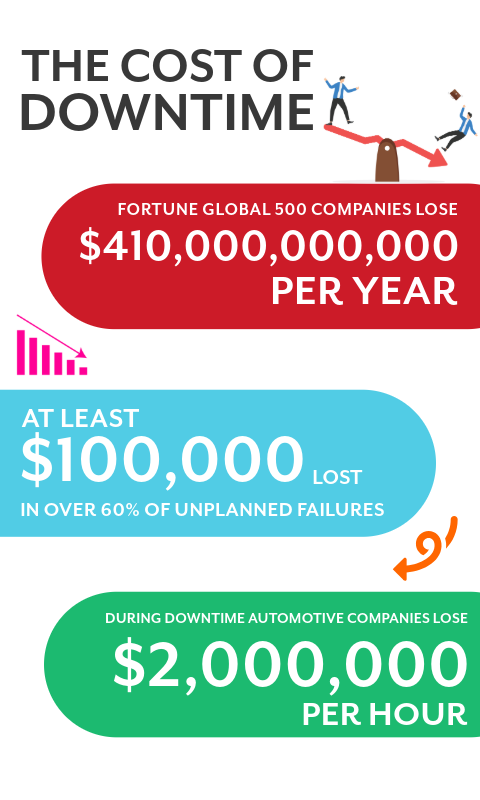
- Over 60% of unplanned failures have resulted in at least $100,000 in total losses and revenue in 2022.
- Unplanned downtime is now costing Fortune Global 500 companies an average of 11% of their yearly turnover. This is $410,000,000,000 in ONE YEAR…
- In the automotive industry, PER HOUR of unplanned downtime results in an average loss of $2,000,000.
What are the most common causes of unplanned business IT downtime?
System Crashes
This can be your computer failing to start, your company’s server has crashed or your cloud storage is offline. Any system which is critical to your business operation experiencing unplanned downtime is said to be the most common cause of financial loss.
Whilst this may seem quite intuitive and obvious, statistics show that even though many business owners and managers are aware of this fact, there is a clear lack of action to protect these essential systems. Do you have a suitable backup solution in place if your system is taken offline? How effective is it? How regularly do you test this backup?
Human Error
This can be from a lack of understanding of your standard operating procedures, failure to adhere to them or lack of training and understanding. Do you have a defined Standard Operating Procedure for the different systems and technology your staff work within your company? Are they given sufficient training for this?
Cyber Security
Phishing Attacks, Ransomware, Malware, the list goes on and the malicious technology development is seemingly never-ending. Failure to keep up to date with sufficient end-point security, staff awareness training, anti-spam and more leads to a significant financial loss for businesses across the globe.
Even though studies have shown business owners and managers are concerned about the rising threat of Cyber-attacks, Half of organizations globally allocate less than 10% of their overall IT budget to IT security. It seems as if this message has not hit home yet for a lot of companies.
Lines of defence against unplanned downtime
Sufficient Service Level Agreements with your IT Provider
A Service Level Agreement is usually an agreed timeframe between you and your IT Provider by which you are entitled to IT Support within a certain timeframe. At Croft, we understand that every one of our clients is different so we work with them to build their IT Support contract to meet their specific requirements.
- Does your IT Support cover your total business operating hours?
- What IT Systems are covered under your agreement?
You can download our FREE SLA checklist which can help you define exactly what support your company needs.
Get your FREE SLA Checklist
The right tools for the job, and maintaining their health
Ensuring you have the correct hardware and software to run your business is the first half of this step, the second is ensuring these systems are kept up to date.
Scenario:
Imagine in 2015, you had brought the BEST server money could buy for your company. It cost an arm and a leg at the time, but it was a much-needed investment. After the installation, you opt out of the ongoing server support and backups and decide to get help as and when your business requires it.
Now it’s 2024, and due to the lack of regular maintenance over the 9 years it has been running, it’s now taking 30 minutes for your staff to complete a task on the server which should realistically only take half of that, and on a random Monday out of nowhere – the server has failed. This unplanned outage completely grinds normal business operations to a stand-still… what do you do?
You reach out to the company who installed your server originally for help, however, with no support agreement in place, the cost of on-demand disaster recovery is hefty.
As there is a lack of backups of your server data – if your server cannot be recovered, this could lead to a loss of all company data which was stored there. As you can imagine, this can have disastrous consequences.
And whilst all of this is going on, your staff are left unable to work.
Whilst the above scenario is fictional, it is based upon the common dilemma we come across in the business industry – IT maintenance and support is typically viewed as something “nice to have” rather than a “must have”, leading to often costly consequences.
Holistic Business Security
Simply installing a free version of anti-virus software onto your office PCs as your first and only line of defence against cyber attacks is getting more and more dangerous by the day.
Malicious attacks can come from all angles:
- A scammer calling on the mainline posing as a client attempting to gain protected data.
- The manager receives an email posing as the owner of the business “authorising” the payment of an invoice.
- A “potential customer” attends your company’s head office and can plug a USB stick into one of the office machines whilst left unattended.
Threats against your business are diverse, and sometimes so elite that it can be very difficult to spot, which is why it is super important to protect your company in every way you can. This can be with end-point security, encryption of company data, protected WiFi networks and more.
Staff Awareness
One of the most important lines of defence which is most commonly overlooked is your members of staff. Keeping your staff up to date with awareness training of your company’s standard procedures and the latest cyber-attacks can greatly reduce the risk of unplanned downtime.
From the examples in the section before, staff training could result in the following outcomes:
- A scammer calling on the mainline posing as a client attempting to gain protected data.
The staff member does not give out any personal information without confirmation of their identity first. This could be a unique customer ID, the account manager’s details etc.
- The manager receives an email posing as the owner of the business “authorising” the payment of an invoice.
The manager talks directly to the owner, whether in person or via a telephone call to confirm whether this email is legitimate.
- A “potential customer” attends your company’s head office and can plug a USB stick into one of the office machines whilst left unattended.
Any unauthorised personnel are never left alone or in a situation where they can gain access to company equipment.
For over 25+ years at Croft IT, we have committed to doing everything we can to prevent unplanned downtime. As a business ourselves, we understand how detrimental it can be not only financially, but for your reputation too. Whether you’re a small business running completely off the cloud, or a large corporate business with multiple sites across the UK – we would love to talk everything IT with you.